
By Dave Dodds, owner of Native Sprinklers Palm Beach, licensed irrigation contractor U-20562
South Florida’s dry season runs from about November to May. It is when Palm Beach County lawns switch from rain-fed to sprinkler-fed, and when every irrigation problem that hid behind summer storms shows up as a brown patch. Here is the fifteen-minute checklist we use on dry-season tune-ups.
Download the printable one-page checklist (PDF) to take out to the yard, or keep reading for the why behind each step.
Why the dry season is when sprinkler problems show up
From June to October, Palm Beach County lawns get most of their water from the sky, and a sprinkler system can be half broken without anyone noticing. Around the first week of November the rain stops, the air dries out, and within ten days every zone that was not pulling its weight shows as a brown patch. Most of the ‘my lawn is dying’ calls we get in November and December are irrigation problems that started in August.
This checklist takes about fifteen minutes. Do it at the start of the dry season and again in February, when the driest, windiest stretch of the year begins.
1. Turn the controller on and confirm the program
Many controllers get switched to Off or Rain Delay during a rainy week in summer and stay that way. Check that it is in Auto, the date and time are right (a power blip resets some older units to January 1), and the program runs on your assigned watering days only. If you use seasonal adjust, set it to 100 percent for the dry season; some people left it at 50 percent from summer.
Not sure which days are yours? See our Palm Beach County watering-days guide.
2. Run every zone for two minutes and walk it
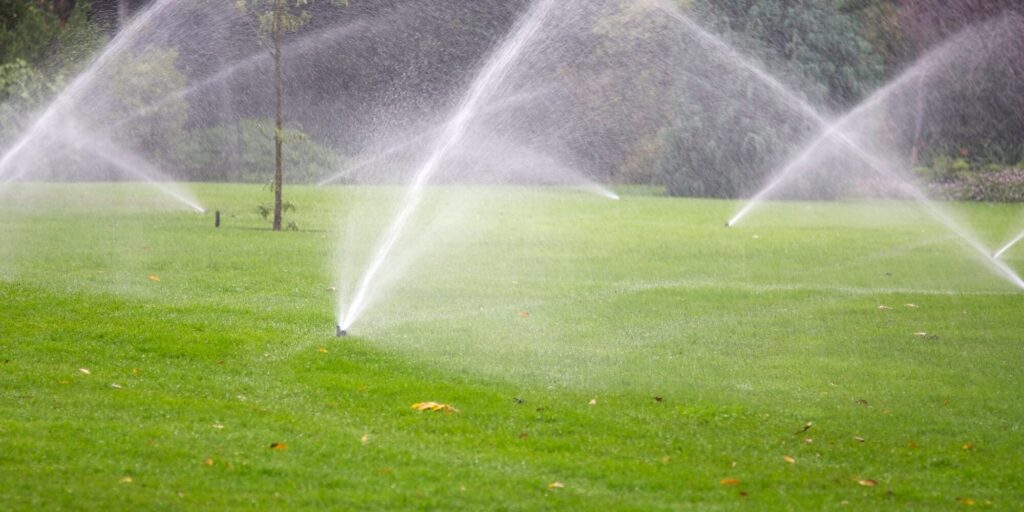
Use the manual or test function and walk the yard while each zone runs. You are looking for: a zone that never comes on, heads that do not pop up or are tilted, heads that spray the street or the house instead of the lawn, a geyser or a soggy patch (broken head or lateral), dry corners that no head reaches, and misting (pressure too high) or dribbling (pressure too low). Write down the zone number for anything you find.
If one zone is dead while the rest run, follow this one-zone diagnosis. If every zone is weak, it is the pump or supply.
3. Clean and straighten heads
Pop-up spray nozzles clog with sand and fertilizer granules over the summer. Pull the nozzle and filter screen, rinse them, and put them back. Straighten heads that have been knocked sideways by mowers; a tilted head waters the sidewalk. Trim grass and ground cover that has grown over heads since spring so the spray pattern is not blocked. Replace any head that is cracked or does not retract.
4. Check the rain sensor
Rain sensors fail in two ways: stuck wet (the system never runs, lawn browns out) or stuck dry (the system runs in the rain, which the water district does not appreciate). Press the spindle on top; the system should pause, then resume when released. Clean out leaves and spider webs. A sensor more than five years old is a cheap replacement.
5. Look at the pump or water source
On well, lake or canal systems, listen to the pump start and check that pressure comes up quickly. Water levels drop in the dry season; a lake or canal intake that was underwater in September may be sucking air in January. On city-water systems, make sure the backflow preventer and the irrigation shutoff valve are fully open, and look for leaks at the backflow.
6. Set run times for the dry season
A good dry-season target in Palm Beach County is roughly three-quarters of an inch of water per zone on each watering day. As a rule of thumb that is about 30 to 45 minutes for rotor zones, 10 to 15 minutes for spray zones and 45 to 60 minutes for drip, run early in the morning. Watering deeply two days a week grows deeper roots than short daily runs, and it is what the rules allow anyway.
If you have a smart controller, enable its weather-based adjustments; if you do not, this is the season when one pays for itself. See smart controllers.
7. Watch the lawn for two weeks
After the checklist, give it two watering cycles. Brown patches that stay brown with a working system usually mean coverage gaps (a head that needs to be added or moved) or a pest or fungus problem rather than water. Patches that green up confirm it was the irrigation.
When to call
Call a licensed irrigation contractor for a dead zone, a stuck valve, a pump that will not prime, a leak you cannot find, or a system that needs heads moved or added. Native Sprinklers does dry-season tune-ups across Palm Beach Gardens, Jupiter, Jupiter Farms, Juno Beach, North Palm Beach, Lake Park and Tequesta, and our maintenance plans schedule this inspection for you every year so you never have to think about it. Request a free estimate or call (561) 622-8166.
Frequently Asked Questions
When does the dry season start in South Florida?
Roughly November through May. Rainfall drops from summer’s near-daily storms to a few inches a month, humidity falls, and lawns go from rain-fed to sprinkler-fed almost overnight. That switch is when hidden irrigation problems show up as brown patches.
How often should I water my lawn in Palm Beach County in winter?
Only on your assigned watering days, two days a week for most addresses, in the early morning. Water deeply on those days, about three-quarters of an inch per zone, rather than short daily runs. Confirm your days with your city or the South Florida Water Management District; the rules apply year-round.
Why is my lawn turning brown in November?
Usually because the system was coasting on summer rain and a problem went unnoticed: a dead zone, a stuck valve, low pump pressure, clogged nozzles, a rain sensor stuck ‘wet’, or a controller that was switched off during a rainy stretch and never turned back on.
Should I turn my rain sensor off in the dry season?
No. Florida requires a working rain shutoff on automatic systems year-round, and it still saves water on the occasional winter front. If the lawn is dry and the sensor is blocking runs, the sensor is stuck or failing and should be cleaned or replaced, not disabled.
Do sprinklers need winterizing in South Florida?
No. Winterization (blowing out lines) is for places that freeze. Palm Beach County does not, so the dry-season job is the opposite: make sure the system actually runs, and runs on the right days.